
When you look at the “Horumon” (offal) section of a Yakiniku menu, do you ever find yourself hesitating?

“Shimacho and Marucho… the names sound different, but what exactly is the difference?”
“Which one has more fat?”
“When is the right time to swallow?”
Many people end up just ordering a “Mixed Platter” or whatever the staff recommends. Of course, that’s one way to enjoy it.
However, knowing the “true identity” and “personality” of each cut makes Yakiniku infinitely more interesting.
Today, let’s dig deep into the eternal rivals of the Yakiniku world: Shimacho and Marucho, and the surprising truth about how to grill them (Kuro5 style).
1. What Exactly is “Horumon”?

Before we dive into the details, let’s clarify the basics.
While “Horumon” broadly refers to all internal organs, in a narrower sense, it often points to the intestines.
Both Shimacho and Marucho are “Cow Intestines.”
Just like humans, cows have a “Small Intestine” and a “Large Intestine.”
- Small Intestine = Marucho, Himo, Kopuchan
- Large Intestine = Shimacho, Tetchan
That is the basic classification. Now, let’s look at their unique characteristics.
2. The Fat Bomb: “Marucho” (Small Intestine)
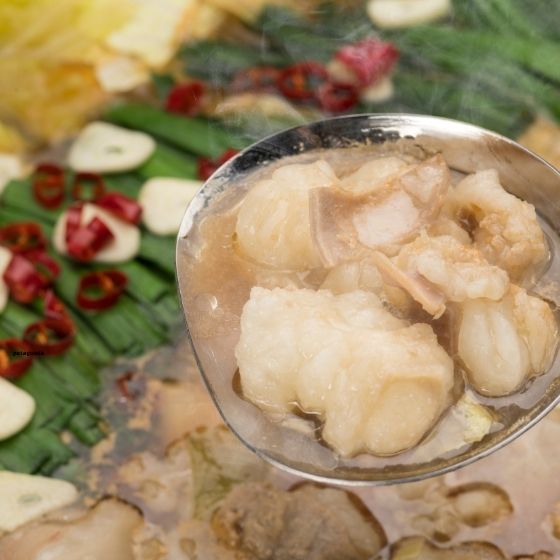
First up is “Marucho.”
As the name suggests (Maru = Round), it is characterized by its round, tubular shape.
Why is it Round? The Hidden “Artisan Effort”
It is commonly said that “it is tubular to keep the fat inside,” but that’s not the whole story. There is a painstaking amount of professional work hidden here.
The small intestine is a very delicate part, and fine dirt or residue can adhere to the area around the fat.
To serve truly delicious Marucho, simply cutting it is not enough.
Believe it or not, the process involves “turning the tube inside out, thoroughly cleaning the area around the fat, and then turning it back to its original state.” (Note: This depends on the supplier and the restaurant’s standards).
Alternatively, some places avoid this laborious process by cutting it open to clean it, serving it flat like Shimacho.
The beautiful tubular Marucho we see is the result of thorough cleaning invisible to the eye, and the chef’s determination to “let you enjoy the texture in its tubular form.”
Taste Profile
The greatest appeal of Marucho is, without a doubt, the “overwhelming sweetness of the fat.”
The moment you bite into it, an explosion of fat bursts in your mouth. Its rich, creamy taste pairs perfectly with white rice. In Korean, it is called “Kopuchan,” meaning Kop (Fat) + Chan (Intestine).
3. The King of Horumon: “Shimacho” (Large Intestine)

Next is “Shimacho.”
Often called “Tetchan” in the Kansai region, this is arguably the representative of Horumon.
Why “Shima” (Stripe)?
If you look closely at Shimacho, you can see striped patterns on the surface of the meat. These are the muscle fibers of the large intestine. Hence the name “Shimacho” (Striped Intestine).
Compared to Marucho (Small Intestine), the intestinal wall is thicker and more muscular.
Taste Profile
The charm of Shimacho is that it is a hybrid of “fat sweetness” and “chewy texture.”
It’s not just pure fat like Marucho; it retains a moderate amount of fat while offering a satisfying, springy texture.
“I love fat, but I also want that savory meatiness to chew on.”
“Marucho is a bit too heavy for me today…”
Shimacho satisfies such mature palates. The more you chew, the more flavor comes out, making it the ultimate partner for alcohol (especially Highballs or Lemon Sours).
4. [Shimacho Edition] Is Common Wisdom Wrong? Why You Must “Grill the Fat First”
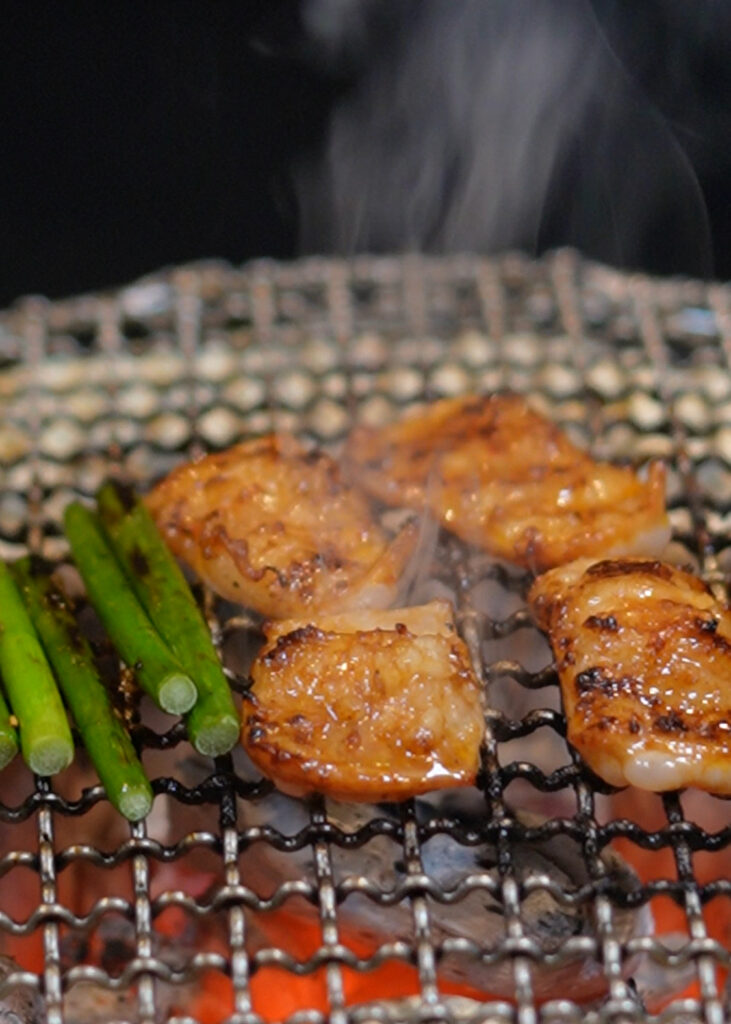
Now, here is the main point of today’s lesson.
Many Yakiniku how-to guides and online articles say, “Grill the skin (meat) side first, and just lightly sear the fat side.”
However, at Kuro5, we declare:
That method is wrong.
Fat Doesn’t Melt That Easily
Some people worry, “If I grill the fat side first, won’t all the tasty fat drip away?”
But think about it. Human visceral fat doesn’t just disappear after a quick session in a sauna, right? If heat alone could melt fat away instantly, dieting would be much easier!
Cow fat is the same. It doesn’t disappear or get tough just because you grill it well.
In fact, if you don’t grill it enough, the fat doesn’t heat up properly, leaving a greasy, unpleasant coating in your mouth.
Conversely, the “Skin” Gets Tough
On the other hand, the striped “Skin” part is muscle fiber. If you grill this side too much, it shrinks tight and becomes hard and rubbery.
The Kuro5 Way: How to Grill Shimacho
- Heat the “Fat Side” Thoroughly
Place the fat side down on the grill first. Grill it patiently to activate the sweetness of the fat.
The trick is to “peek” at it by lifting it with tongs to ensure it doesn’t burn. Grill it until it’s just short of burning. - The Skin Side Needs Only “1 Minute”
Once the fat is sufficiently heated, flip it over to grill the skin. This should be quick. About 1 minute is enough.
“Grill the fat well, sear the skin lightly.”
This is the true rule to make Shimacho taste its best.
5. [Marucho Edition] Aim for “Melting Inside, Crispy Outside”
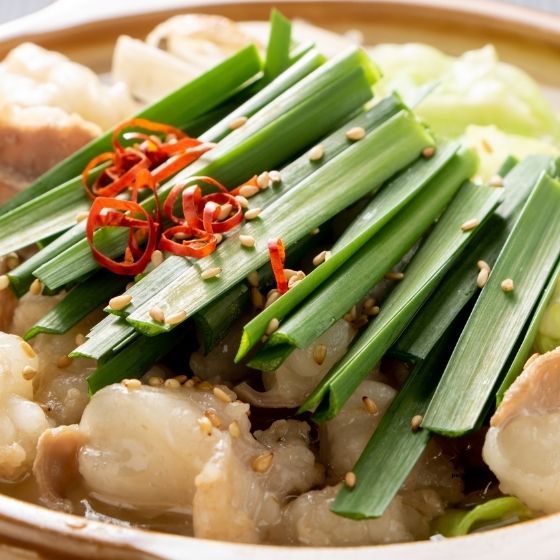
So, what is the correct way to grill the tubular “Marucho”?
Since the fat is packed inside the tube, the structure—and strategy—is different.
The Ideal Form is “Motsunabe” (Offal Hot Pot)
Let’s digress for a moment. What is the most delicious way to eat small intestines?
Ideally, it is “Motsunabe.”
Simmered in a hot pot, thoroughly heated small intestines become soft, and the fat turns gelatinous and melting.
Eating it with chives and bean sprouts in a soy sauce-based soup neutralizes the heaviness, making it endlessly edible.
Conversely, if the heat doesn’t penetrate deep enough, the internal fat remains hard and can cause stomach heaviness.
How to Recreate “Motsunabe” Texture on a Grill?
How do we achieve that “melting texture” with Yakiniku?
The answer is: “Grill the Skin (outer layer) until it is crispy.”
By thoroughly grilling the outer tube until it’s crispy, the heat transfers to the internal fat, effectively “steaming” it inside its own casing.
This changes the internal fat into a trotter-like texture, similar to Motsunabe.
- Outer Skin = Crispy and fragrant
- Inner Fat = Hot and melting
This contrast is the real thrill of Marucho. Don’t be afraid to grill it well!
6. Solving the “Diffculty” with Kuro5 Style
Thank you for reading this far.
You might be surprised by facts like “Grill the fat first” or “Grill until crispy.”
“I understand the theory, but checking it constantly to prevent burning seems hard…”
“I was busy talking and realized I burned it black…”
Please rest assured.
At “Yakiniku Kuro5,” we do not ask our customers to hold the tongs.
Bincho Charcoal x Full Attend Service
At Kuro5, we use “Bincho Charcoal,” which is difficult to handle but produces the best aroma. We also adopt a “Full Attend” style where trained staff grill all the meat for you.
Our staff knows exactly how to warm the Shimacho fat to the limit without burning it, and how to crisp the Marucho skin perfectly to melt the fat inside.
- Careful preparation (cleaning) to remove odors
- The aroma of charcoal
- Perfect heat control by professionals
All you have to do is carry the meat to your mouth at its most delicious moment.
“I didn’t know Horumon could taste this good!”
We invite you to experience this surprise at Kuro5.
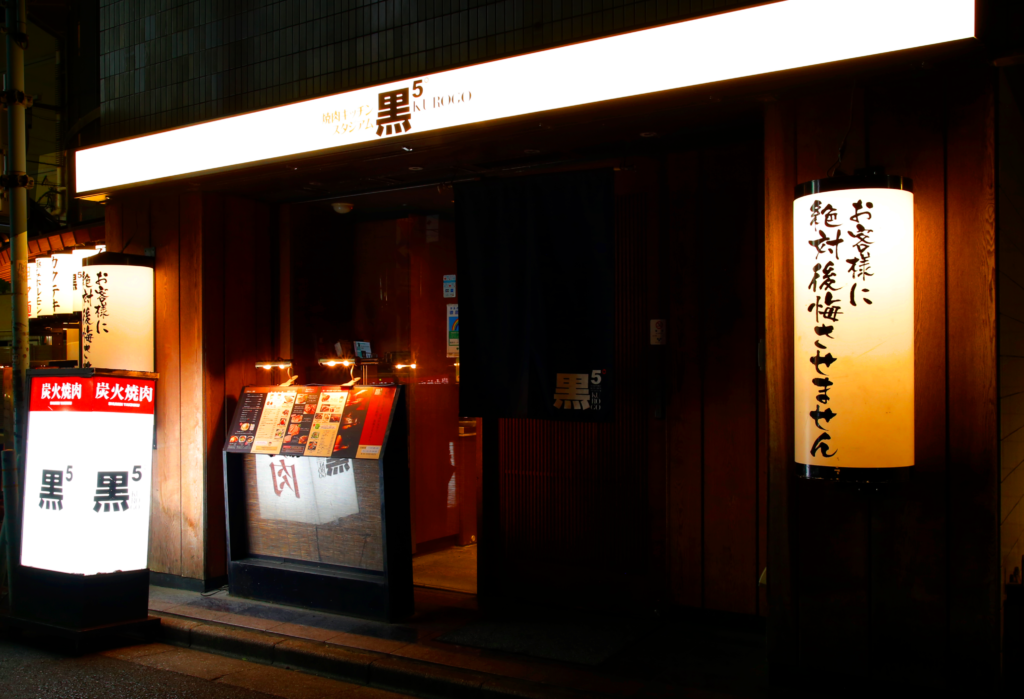
Wagyu Yakiniku Kuro5
IKEBUKURO Main Restrant
1F Shima 100 building ,2-46-3, Ikebukuro, Toshima-ku , Tokyo 171-0014
https://en.kuro5.net/restaurant/honten
Wagyu Yakiniku Kuro5
IKEBUKURO East Exit Restrant
2F Need Building, 1-42-16 Higashi-Ikebukuro, Toshima-ku, Tokyo 170-0013
https://en.kuro5.net/restaurant/higashiguchi
Wagyu Yakiniku KURO5
Kabukicho
1F Sankei Building, 2-21-4 Kabukicho, Shinjuku-ku, Tokyo
https://en.kuro5.net/restaurant/kabukicho
Official Instagram: @kuro5yakiniku

